Your Questions About EU GDPR: What Is It And How To Make Sure Your Webstore Is GDPR Compliant

EU GDPR: What Is It And How To Make Sure Your Webstore Is GDPR Compliant

Everyone is talking about EU GDPR and its effects. Let’s find out the definition of GDPR and talk about its impact on your dropshipping business!

Data protection is no joke.

Everyone needs privacy and safety while being online, and of course, everyone wants to shop online with confidence.

This is why there’s such a buzz around EU GDPR, the newest set of legal requirements that regulates the storage and use of online shoppers’ personal data.

Let’s try to figure out what it is, exactly!

What does EU GDPR stand for?

GDPR is an abbreviation that means General Data Protection Regulation.

Simply speaking, it is a regulation in the law system of the European Union. The main idea behind GDPR is to protect the personal data of EU citizens, and to guarantee their privacy.

What will happen to GDPR in May, 2018?

The basis for GDPR was introduced in 1995 – as you can guess, the world of informational technologies has changed radically over these years, and it’s now really necessary to edit the regulation.

This is why in April, 2016, the updated version of GDPR was adopted. It will come in effect on 25 May 2018.

What’s the GDPR 2018 summary?

A brief GDPR overview makes it clear that the new regulations oblige companies to be more careful while storing and processing the customers’ personal data.

What does it mean?

Let’s go over the most important aspects – you can find the full explanation of the updates here.

You must follow the regulation if your customers are EU citizens

It doesn’t really matter where your business physically exists, or where it is legally registered. Generally speaking, if your website visitors are EU citizens, you must ensure the full protection of their personal data, and modify all of your data policies in accordance with the GDPR requirements.

Any piece of the website visitor’s data can be considered personal

Interestingly enough, the updated version of GDPR doesn’t give the exact definition of personal data and the types of information details that must be protected under the new regulations.

Still, the European Commission’s official website explains that any pieces of information that can possibly be used to identify the personality of the website visitor can be classified as personal data.

It means that online store owners must be exceptionally careful about the following pieces of information provided by their clients:

  • Name and surname
  • Email address
  • Home address
  • Identification card number
  • Location
  • IP address
  • Cookie ID

These (and some else) personal details must be handled in full accordance with the GDPR.

The website must ask the visitors to give their consent on the data usage

Simply speaking, there must be some kind of a designated page, or a form, or a pop-up window that:

  • Explains what kind of personal data is collected on this website, who will get and use it, and for what purpose (in clear terms and a simple language)
  • Asks the visitors to confirm they agree to provide this kind of information
  • Makes it possible for a user to easily cancel this agreement and withdraw the consent

The website must notify the visitors about data breaches

If the website gets hacked, or something similarly dangerous happens to it, there is a chance that the visitors’ data might have gotten stolen.

The companies must notify their buyers and website visitors about such events within 72 hours of discovering the breach.

The website must provide its visitors the right to access the gathered information

So, the webstore visitors now have the right to ask what kinds of personal details this website collects, and how the data is used.

The website, in turn, must be able to provide the necessary explanation on an electronic format and tell what’s the purpose of collecting and using these details.

It must be possible to delete a person’s data upon request

The website must have a technical possibility to erase personal data of an individual, stop it from further spreading, and prevent it from being used by third parties if an individual asks for it.

Is it really necessary to make my store a GDPR-compliant site?

Absolutely!

Even if you’re not residing in the EU and aren’t specifically targeting the EU customers, the global nature of drop shipping means that anybody can stumble upon your website, and order something from you.

Across different countries in the European Union, there will be set special Supervisory Authorities (SA): their purpose is to perform websites audit, issue warnings for non-compliant websites, and suggesting improvement measures for every particular case.

According to the updated version of GDPR, non-compliant organizations will need to pay a penalty charge. It can be amounted up to 4% of the company’s annual global turnover, or €20 million (whichever is bigger).

What exactly do I need to make a GDPR-compliant store?

Follow this step-by-step guide, and it will be fine!

1. Revise the types of data you collect

Since you’re running a drop shipping store, most likely, the personal details you gather are names and surnames, email addresses, physical addresses, phone numbers, payment details…anything else?

This analysis is a good reason to rethink your questionnaires and data forms (if you have any): both you and your customers will benefit from the renewed, ‘minimalistic’ forms.

As you probably remember from our conversions boost guide, the less details a shopper has to provide during checkout, the more likely he/she is to complete the purchase.

At the same time, a short personal details form fully matches your interests, too. Your goal is to gather only the strictly necessary personal info: if you don’t collect unimportant data that is not required for the order processing, you don’t have to protect it – and you don’t have to explain your visitors why you need to know their eye color or Zodiac sign.

2. Think who you share these details with

At this point, you can surely say what types of customers’ data you collect. Now, it’s time to think whom you provide with these personal details.

Typically, you share such info with mass mailing services (Aweber, MailChimp, etc.), with outer plugins and themes, and, obviously, with AliExpress sellers.

Mostly, you need this breakdown to give a clear data usage explanation to your clients – later, in your privacy agreement, you’ll list all your partners/technical solutions and clarify who uses the personal details, how exactly, and for what purposes.

Also, if you have a list of entities/tools that have some kind of access to your clients’ personal data, you can conveniently go through this list and find out whether each one of them is GDPR compliant. It’s a good idea to only do your business with those who stick to the new regulations.

3. Write a new privacy note

It’s wise to have a separate website page designated specifically for this purpose, but you can also write it all on your Terms and Conditions page.

First, write that your webstore is GDPR compliant.

Then, write the full list of personal details your webstore collects (IP address, the type of device used to browse the site, cookies, the visit duration, email, phone number, physical address, postal address, etc.)

Then, repeat the same list, and specify who exactly uses the collected personal details, and for what purposes (for example, Google gets the device information and visit duration within the sphere of Google Analytics goals tracking, Aweber uses email addresses to send mass emails, manufacturers/stock owners use the order product details to assemble the packages, delivery companies use the buyer’s physical address to send the orders, etc.).

Then, explain (in simple and understandable terms) that every store visitor has the right to demand a copy of his/hers personal details collected by you, and can even ask you to delete all these details permanently.

Then, write a specially created email address: it will be the emergency contact address for the people who have questions or requests about their data privacy. Don’t use this address for any other purposes, and don’t show it in your regular contact details – this way, you’ll be sure that every letter coming on this address is related to this particular issue.

Finally, write that if after reading this, the visitor keeps browsing the site, it means he/she fully agrees with these terms and gives full consent to use his/hers personal details for the legally approved and business-necessary purposes. If the visitor doesn’t agree to the terms, he/she must leave the site immediately. If the person has already given consent to use his/hers data, but now wants to withdraw it, he/she should contact you by email and ask to delete all the data.

Please note: since May, 25th, every new custom-made store developed by AliDropship team has a GDPR-compliant ‘Terms and Conditions’ page that covers these basic points. Clearly, the details (contact email, the list of third parties using the personal info, etc.) should be amended by the owners of these stores because every business is managed in its own unique way.

4. Set up a pop-up or a push notification on your landing page

This is a highly useful action if you want to prevent the cases of misunderstanding (for example, if your store visitor claims he/she has simply looked through the products in your store and hasn’t specifically visited the privacy note page, and therefore, hasn’t given the consent to collect his/hers data).

To ensure your own safety, you can set up a privacy notification that appears when someone visits your site. The message should say that:

  • The website collects some personal details of every visitor
  • It is recommended to read the full explanation of the webstore’s privacy policy (here, you provide the link to the page with your privacy note)
  • By clicking ‘OK’ on this notification, the visitor confirms he/she has read the privacy note and agrees with its terms

For this purpose, you can safely use the GDPR Banner plugin for WordPress: it helps you create a catchy banner that is linked to your privacy policy page.

5. Think how to handle every procedure

Under the new regulations, you must be able to:

  • On a visitor’s request, show what kind of this visitor’s data you’re collecting
  • If necessary, delete a user’s personal details
  • If required, withdraw a user’s consent to further use his/hers personal data

Do a little research and pick the relevant plugins that would perform these tasks if necessary: developers all over the globe are currently offering various GDPR-friendly solutions for WordPress that can make your webstore more compliant with new regulations.

Our team has tested several options, so we can recommend GDPR plugin that covers a wide variety of the necessary tasks, and Delete Me plugin that specifically allows users to delete their data from a particular website.

6. Improve the store security

If your store is well-protected from malware and hackers’ attacks, most likely, you won’t have to deal with security breaches.

Read this article to learn how to make your website secure.

7. Think what to do if a data breach still happens

According to the new regulations, as soon as you learn about a data breach, you need to do the following within the next 72 hours:

  • Write down its details and keep a record of every incident
  • Report the incident to the local Data Commissioner (supervisory authority)
  • Notify your clients about the breach in case it threats their personal rights and freedoms

8. Consult your local lawyer

We strongly recommend you to get legal advice concerning the GDPR: many of the statements in the new regulation are quite ambiguous, and if you want to interpret them in the most favorable way for you, it’s necessary to discuss it with a professional lawyer.

Now you have a general idea about EU GDPR and its influence on your business. Don’t worry – with the due preparation, you’ll keep enjoying your thriving drop shipping store without any troubles!

This image has an empty alt attribute; its file name is shopify-banner2-1.jpg

All Entrepreneurs Do It: 9 Ways to be Successful in Business

how to be a successful entrepreneur

Have you ever found yourself looking up the internet in search of some cookie-cutter solutions how to be a successful entrepreneur? And does it really make any sense? Everybody knows that there’s no magic pill, and it’s not enough to read a pair of books on business to become Jeff Bezos or Mark Zuckerberg. Still, there are some things that most prosperous businessmen have in common. Let’s see what distinguishes a good entrepreneur from a second-rate one.

Of course, no one can learn to swim just sitting on the shore and reading the articles like “10 Influential Books You Need to Read to Become a Great Swimmer”. There is no other way to learn to swim than to jump into the water; to become a good entrepreneur, you should first of all run your own business. Anyway, there are some points that you should bear in mind and some guidelines to follow. Study our tips and think over the points that you should master.

How to be a successful entrepreneur

Don’t be afraid of mistakes

Maybe you are a unique prototype of a leading-edge robot created by a brilliant scientist. You are programmed to make perfect decisions and always choose the best option of all the possible. And you never make mistakes. So, you can miss this point and pass to the next one.

All the other people make wrong decisions from time to time, and there is nothing terrible about that. This is business, not mathematics or physics – there are no ironclad guarantees. If you have chosen wrong products for your store, oversaturated your landing page with pop-ups, met disreputable supplier or was cheated by a credit card fraudster – it’s not the end of the world. You’ll know better next time. Keep calm, fix it and move along.

Seek ways to work smarter

Try to minimize manual routine actions that are your main time robbers. You’ll be surprised how many of them can be automated.

For example, if you run your dropshipping business with AliDropship plugin, you’ll be relieved from the problems with pricing, placing and tracking orders, updating products, etc. The plugin does all these and many other things for you.

Promotion also can be automated with the help of special tools. Such great SMM solutions as Social Rabbit plugin can save you up to 40 hours a week!

Don’t try to keep every tiny detail in your head – use planners, calendars, sticky notes and other things that were invented to make our life easier.

Learn from the others’ experience                                                                   

A smart entrepreneur knows how to combine business with pleasure. Reading success stories is a good way to spend your free time profitably.

There is always someone who is smarter, richer, more experienced and prosperous. Such guys have a lot to learn from. Luckily, many successful ecommerce entrepreneurs are glad to share their practice and knowledge with newcomers. So, reading their pieces of advice in blogs or on thematic forums is really helpful and inspiring.

Their valuable experience – both positive and negative – can give you the cue to some problem or save you from making a mistake.

your-own-business-pic

How to run a winning business

Evaluate and manage risks

Taking risks is an integral part of any eCommerce venture since a calculated risk means a good opportunity.

“The biggest risk is not taking any risk… In a world that changing really quickly, the only strategy that is guaranteed to fail is not taking risks.”  – Mark Zuckerberg

Anyway, pay attention that taking risks doesn’t mean going nap blindly. Any risky step requires a thorough analysis. Weigh all pros and cons, and if the risk is justified, get moving. This is the only way to develop your business and leave the competitors far behind.

Use complaints for further development

What is the main task of any business, including eCommerce? It must satisfy consumers’ needs. Retail enterprises must be client-oriented, and online trade is not an exception.

Your customer’s complaints help to find out the weaknesses of your business. Each time you have an unsatisfied customer, you face a wonderful opportunity to master your skills of customer service, to identify the weak point in the process and to fix it.

How do entrepreneurs become successful

Create long-term strategy

Actions without a plan and control are chaotic and unorganized. Even if they lead to the result, it will be difficult to track what algorithm worked there. Therefore, planning is your first priority.

You should have a clear view where you want to find yourself in a month, in a year and five years later. Formulating your main goal is the first step of planning process.  Your long-term strategy will determine your everyday tactics. The more effective and accurate it is, the faster the goal will be achieved.

Establish clear goals

The previous point is impossible without this one. There is a great purpose you set your sights on. To achieve it, you should clearly understand where to and how to move. Split your long way into small steps.

Needless to say that your goals must be real, attainable and tangible. Unfortunately, quite often companies either do not formulate goals at all, or operate with such non-specific things as “increase profits” or “work faster “. This will lead you to nothing. A detailed step by step plan with specific numbers is much more realizable than a vague idea “I want to be a millionaire”, isn’t it?

prosperous-businessman-pic

Ways to be a successful entrepreneur

Delegate tasks

Even if your business is young and small, and you think that can manage all by yourself, there may be some things that are better to be passed to someone else. You cannot be equally good at everything – graphic design, web development, copywriting, SEO, multimedia production, and what not. This is why you’d better hire specialists to solve some tasks.

If you are not an expert in some field, it’s logical to delegate it. For example, a professionally designed website is more attractive and user-friendly, and you will have a chance to concentrate on other things which you are good enough at.

Never rest on laurels

Keep on challenging yourself. Running a successful business is impossible without ambitions. A good entrepreneur always wants to keep growing, to provide a better service, to run more effective promotion campaigns. You shouldn’t simply want to be better than your competitors – you should aim to be better than you were yesterday. Look for new growing points, soar for new heights, and one day we’ll be glad to read your success story!

Factors of success are many and various, and one can hardly explain how to be a successful entrepreneur in several simple words. But if you start your own dropshipping business with a ready-to-go custom store, you’ve got excellent chances to go far in the world of eCommerce!

This image has an empty alt attribute; its file name is shopify-banner2-1.jpg

Fantastic Affiliate Marketing Success Story: Eartha Shares Her Life-Changing Experience

affiliate marketing success story

Affiliate marketing success is often viewed as something unrealistic: traditional affiliate programs don’t give the participants the opportunity to earn their living, and sometimes, cause more trouble than benefits. Still, there is an exception to every rule.

The volume of profit you receive from participating in any program of this kind (and therefore, your affiliate marketing success) heavily depends on the terms and conditions dictated by the merchant.

This is why various affiliate programs offered by AliExpress, Amazon, etc., don’t really have a future: commission fees are so humble and payment restrictions are so abundant that hardly anybody would rely on these programs in search of a stable source of income.

But, there still is something valuable that you can get out of these programs: I’m talking about knowledgeexperience, and, most importantly, courage.

For thousands of people around the globe, the world of online business is unfamiliar and somewhat scary. For them, getting registered in an affiliate program means making their first steps in the ecommerce field – and later on, these steps can turn into a full-scale online business journey.

Understanding this, our team has developed its very own, independent affiliate program that both serves our interest and introduces entrepreneurs worldwide to the concept of dropshipping.

The best part? It’s more generous that you would expect!

How AliDropship supports your affiliate marketing success

To begin with, AliDropship affiliate program is free to join: even if you’ve never been the client of AliDropship before, or if you have absolutely no idea about the dropshipping mechanism at all, you can still register in the program – it will cost you nothing to participate.

After you get registered, you get your special affiliate link – you can freely put it in any type of the content you’re creating online (for example, the posts in your social media accounts, or the articles you’re writing in your blog, or the videos you’re adding to your YouTube channel, etc.).

What is more, you also receive a ready package of professionally crafted advertising materials from AliDropship marketing specialists: if you don’t have enough experience in promotion yet, you can safely use the ready-made banners, texts, etc.

So, your aim is to raise awareness about AliDropship solutions, and motivate your followers/readers/viewers on purchasing something from the company. Every purchase that was made through your affiliate link is tracked by a dedicated specialist, and, as the result, you receive a lucrative commission for every order that was placed with your help.

Yes, you’ve read it right.

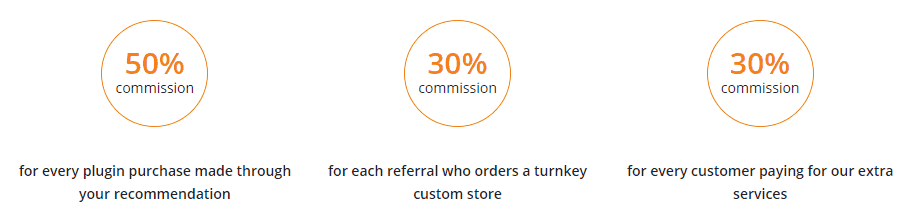
You receive 50% commission for every purchase of AliDropship plugin that has originated from your affiliate link.

You earn 30% commission for every sale of a custom store, any add-on, or any service that happened thanks to you. In fact, it means than you can get up to $284 from a single sale: it happens if a person orders the ultimate custom store package together with 1-year hosting via your affiliate link.

This way, AliDropship affiliate program gives you the following:

  • An online business with zero startup costs

Many people just can’t afford launching their own ecommerce business as they literally have no financial savings for this purpose. For them, this program is an affordable way to source the money for the venture of their dreams.

  • Extended knowledge in dropshipping

While creating promo materials to put the affiliate links in, the program participants eventually learn more about the essence of dropshipping, and, as they gain both the knowledge and the financial backup, they gain the opportunity to go further.

  • Motivation to get a self-owned business

When the affiliates feel confident and knowledgeable about the niche they’re taking, they naturally get interested in building their own, independent businesses. For them, AliDropship affiliate program becomes the first step on the ladder to success.

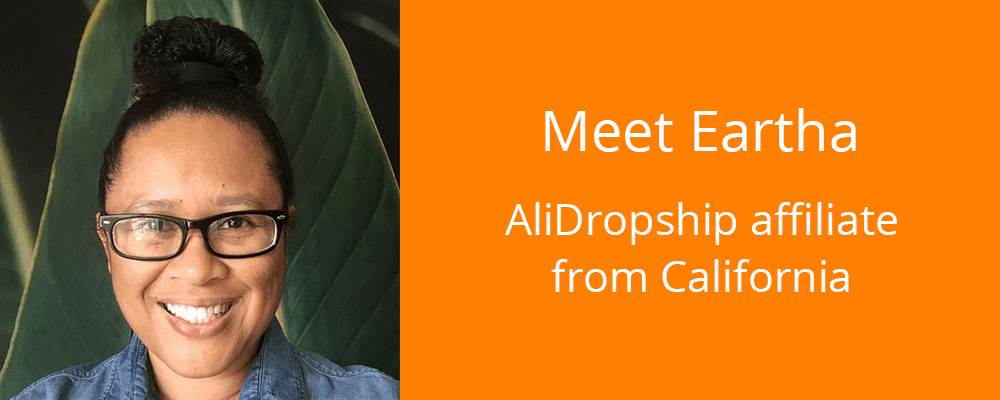
And, speaking of affiliate marketing success, I must surely mention Eartha – one of the most prominent participants of AliDropship affiliate program. She does an incredible amount of work to spread the word about our solutions (and her earnings are quite impressive, too).

So, let’s listen to her first-hand experience!

How to be a successful affiliate marketer: Eartha’s story

Hi, please introduce yourself!

My name is Eartha and I’m from sunny San Diego, California. I have a background in web developing. My previous job involved creating WordPress websites for attorneys.

Did you have any previous experience in e-commerce/affiliate marketing?

My only experience with eCommerce was when I did freelance web work. I installed and helped manage an eCommerce store for a former client. I had a tiny bit of experience with affiliate marketing from learning about it many years ago.

Why did you choose affiliate marketing, after all? How did it all begin?

Years ago when I got my very first web job, I decided to search for a new job that was closer to home. I was commuting two hours a day (to and from work) and was tired of it.

I went on a job interview in which the owner made millions selling an eBook teaching people how to make money online.

I didn’t get the job but it was my first exposure to affiliate marketing. Once I learned about affiliate marketing, I was hooked. I immersed myself in the topic and I knew that I wanted to pursue it full-time.

Unfortunately, I didn’t take affiliate marketing seriously until I was laid off from one of my previous jobs. It was then that I decided to pursue my dream of being an affiliate marketer.

I had to get another job in the meantime. However, I also found an online course that I liked, followed the training, and worked hard on my websites. I was able to transition into working for myself fifteen months after starting that job.

How did you learn about AliDropship products and AliDropship Affiliate Program?

I am always on the lookout for different types of online business models. I was interested in dropshipping but I wanted to find a WordPress solution. I read about the AliDropship plugin online and visited the website. I immediately liked what I found and purchased the plugin right away. I wrote an article about the plugin in my blogand began to get traffic to the article. I searched to find out if AliDropship had an affiliate program and it did! I signed up and have been promoting it ever since.

Do you participate in other affiliate programs?

Yes, I promote other affiliate programs. Primarily, it’s products and services that I use in my own online business.

What are the most difficult challenges of being an affiliate? How do you deal with them?

One of the biggest challenges is being self-disciplined. When you work for yourself, it is easy to slack off. I could easily spend my days wasting a lot of time hanging out, browsing social media, etc. I deal with this challenge by creating a work schedule for myself. I wake up at the same time each morning and follow a routine. I know that the work I do today will pay off 6 months down the line. However, I still enjoy the flexibility of working for myself. It is nice being able to go to my appointments without asking permission from an employer. It is also great to take days off when I want.

How much time does it take you every day to manage your blog/Youtube channel? Which task(s) demand more time than others?

I probably spend an unhealthy amount of time on my computer. Some days I can work all day and into the night. However, on most days I work between 4 and 6 hours. That includes writing content for my blog and creating YouTube videos.

How has your life changed? What do your friends and family think about your business?

I am a lot happier as I get to spend my time working on projects that I love. I am able to be creative and it is a lot of fun to see the work I’ve done create income. My family and friends have always been supportive. They don’t necessarily understand what it is that I do but they are happy because I’m doing what I love.

What are your plans for future?

I want to create a large portfolio of websites in various niches as well as create an online course of my own.

What can you advise our readers – those who already work as affiliates and those who didn’t become an affiliate yet?

My best advice for new and experienced affiliate marketers is to stay consistent. I wasted a lot of time jumping from one thing to the next. I didn’t find success until I focused on one thing and put in consistent effort.

We are sincerely grateful to Eartha for such an honest and extended feedback, and we hope it will inspire you to join our program: your affiliate marketing success will open the door to new opportunities in your professional and personal life!

This image has an empty alt attribute; its file name is shopify-banner2-1.jpg

‘It’s The Same Old Importing From China’: 7 Dropshipping Stereotypes

Is Dropshipping The Same AS Importing From China?

Dropshipping is a relatively young business model, which is why not everyone is well-informed about its benefits yet. Quite remarkably, some of the newcomers even think that this venture is identical to traditional importing from China! So, in order to fulfill our educational mission, we will investigate the most common dropshipping stereotypes – and help YOU change your life to the better thanks to this incredible venture.

Okay, here’s the axiom: if you have a low opinion of dropshipping, you don’t know much about dropshipping.

Yes, this is one hundred percent true.

The better you understand the mechanics and the distinctive features of this business, the more excited you get about the benefits of this awesome type of ecommerce enterprise.

Shall we begin uncovering the truth about this business model?

Myth #1 Dropshipping is an ordinary importing from China, but with a fancy name

Some people think that the whole existence of dropshipping is just a ‘marketing’ trick. In their opinion, it’s like using a ‘cleaning service manager’ job title instead of a simple ‘janitor’ word: the smarter the term, the easier it is to deceive the unsuspecting public, right?…

In reality, dropshipping is strikingly different from the traditional scheme of buying Chinese items upfront and reselling them for a higher price. Watch this video to see the differences:

Summing it up, if you are dropshipping, you:

  • Buy no items

You don’t spend a single cent on buying any products from your suppliers, and you don’t deal with things like customs clearance, customs tax payment, etc. So, you can basically start this business at any point of your life: your start-up expenses are really low, and you don’t need extra savings. Besides, you don’t have any risks of going bankrupt even if you accidentally choose wrong items to show in your dropshipping store. As you haven’t really bought these undemanded items, you have no headache over getting your money back – and you can easily change the product offer in your store with no financial or reputational losses.

  • Keep no physical stock

Since you’re not buying any items, you’re not having any troubles with keeping them safe and secure. This means, there is no need for you to rent a warehouse, or to hire staff to keep an eye on the stock. So, your product-related costs amount to zero!

  • Arrange no shippings

If your client buys an item that you physically possess, you have to deliver it to the buyer. But, if your customer purchases a product through your dropshipping store, you have absolutely nothing to worry about: the product is located at the original supplier’s place. So, all you need to do is transfer the order details and the buyer’s address to the supplier: all the rest is beyond your responsibility.

As you can see, even though this business model means that (roughly speaking) you’re selling Chinese-made items to your buyers, it is quite far from the traditional direct import from the original supplier. You’ve noticed how huge your financial savings are, right?

Myth #2 Even if you’re dropshipping instead of importing from China directly, you still deal with locally manufactured low quality products

Not necessarily.

I mean, yes, the most convenient place to source your dropshipping products is AliExpress, so technically, you’ll be selling Chinese items in your store. But, who says they will definitely have a poor quality?…

Thanks to our own broad experience in dropshipping, we have learned the most efficient ways to modify AliExpress search bar settings while sorting out the goods on offer. Besides, we have mastered the skill of analysing the product prospects, and shared the gained knowledge in a super extensive manual on choosing the best AliExpress items for your business. Following these simple recommendations, you will stay away from shady sellers and shabby products, and will only offer carefully handpicked items to your potential customers.

Myth #3 Dropshipping profits are so small and irregular that they aren’t even worth all the effort

That’s probably one of the most popular ‘urban legends’ about dropshipping business. This misconception is based on the following thought: in order to get a sufficient profit from every sale, you need to put a considerable markup on each product price – and it will scare off the potential buyers.

But, this is exactly one of the reasons why we recommend using AliExpress as your product source! As the majority of the items are low-priced, you can safely make them cost more – but even with a good markup, the final price will still be acceptable for your customers.

And speaking of the ‘small’ profit… well, look at Mousslim from France who made $3,500 in his first 45 days of doing dropshipping. Or, make yourself familiar with the experience of Martin from the Netherlands who made over €4,100 in 30 days of running his dropshipping store. Or, get inspired with the feedback of Rahul from Indiawho went from 0 to $12,000 in 5 months of managing this business. Both our success stories blog section and dedicated forum thread are filled with real-life stories of actual people who did their best and succeeded with their dropshipping ventures; what makes you think you can’t do the same?

Myth #4 On the package label, your buyer will see you’re importing from China – and it will ruin your reputation

To me, this is one of the funniest arguments against starting a dropshipping business.

Indeed, let’s assume that your buyer receives the package, examines the wrapping paper carefully, and notices Chinese characters, or a Chinese shipper’s name/address.

Now what?

There’s nothing suspicious about it, given that an impressive number of warehouses and manufacturing facilities of the largest global corporations are physically located in China. Plus, the majority of AliExpress sellers are extremely kind to dropshippers (for both sides, it’s a mutually beneficial partnership), so it’s more than acceptable to contact your seller and ask to remove all the promotional leaflets and other irrelevant materials from the package.

If you want to play safe, you can even write it plain and clear on every product page: “The item is kept in our warehouse in China, which is why its average delivery time is 28-35 days depending on the buyer’s location”. With a phrase like this one, you will basically kill two birds with one stone: read what I’m talking about below.

Myth #5 Long delivery time will make the store visitors abandon their shopping carts

If this particular idea bothers you, think of the following: 95% of actions taken in a dropshipping store are driven by emotions. In fact, the whole success of your venture mostly depends on your ability to create a sense of urgency: an in-store atmosphere that promotes impulse purchases.

This is the main reason why a long delivery time won’t be a major negative factor for your clients: they don’t buy your products because it’s a life-critical necessity. They don’t need these items to be delivered immediately; they just want to own them because these products are cute and lovely! Plus, with a smart tech solution at hand, you can always get in touch with the abandoned cart owners, and persuade them to complete the purchase.

Myth #6 Contrary to usual importing from China, dropshipping requires you to be an IT person

When it comes to automated solutions that make a dropshipper’s life 10 times easier, some people get confused, and start worrying a bit. They assume that it’s strictly necessary to deal with coding, to possess advanced tech skills, and to have a website development background.

In reality, the only obligatory piece of knowledge here is the understanding of dropshipping process itself. To help you out with this, we put all our experience and recommendations in this single monumental guide. Read it carefully, and it will be much easier for you to manage your dropshipping business with a healthy profit.

And, with regard to the tech part, we also have something to offer you: here is the easiest way to get your own independent dropshipping business with no technical efforts whatsoever! The lack of IT skills can never stop you from launching and keeping your own fruitful venture because you can simply order a customised store that is fully ready for operation and is assembled by a professional team of developers and designers. That’s a too hot opportunity to miss!

Myth #7 If you keep promoting dropshipping so hard, everyone will start doing it, the bubble will burst, and the industry will collapse

And why on Earth would that happen, I wonder?

As long as you promote your dropshipping store carefully and update its product range on a regular basis, you will always have enough buyers. For many reasons, your store will seem even more appealing to the clients than AliExpress or Amazon!

Plus, the future of dropshipping industry looks brighter than ever: we have collected and analysed some market-related stats in this article, and I strongly recommend you to read it if you have any doubts over the long-term prospects of dropshipping business.

Did I manage to convince you that plain and boring importing from China stands no chance against dropshipping? It’s the adventure time!

This image has an empty alt attribute; its file name is shopify-banner2-1.jpg

Pros And Cons Of 7 Top Online Business Ideas For College Students

business ideas for college students

Today, we are evaluating several business ideas for college students; university freshmen, high school graduates, and other ecommerce newbies might get interested in these findings, too!

For a student, running a self-owned (and a physically existing) venture might seem to be quite a daunting task, given all the challenges of combining full-time studies with entrepreneurial efforts. This is why online business gets considered by this audience so often; still, even this type of moneymaking activity certainly has some limitations.

What are the criteria for picking the best online business ideas for college students?

Obviously, not every kind of online business is suitable for a student or high-schooler. Ideally, the perfect venture should be:

  • Affordable to launch
  • Flexible enough to be run at any time or from any location
  • Not related to crafting, manufacturing, buying, stocking, and shipping physical products

All of these limitations are obvious: it’s not entirely possible to combine your studies with solving the numerous product issues (especially the ones related to actual manufacturing), and it’s not always easy to cope with the timing pressure, to say nothing about getting through overly high startup costs.

So, what are the options of launching a student-friendly online business that requires no inventory?

Knowledge-specific online business ideas for college students

Detailed knowledge of a demanded subject and well-developed academic skills can serve you well if you use them wisely.

#1 Temporary freelance job

Thanks to the platforms like Fiverr, you can offer paid help to the people looking for assistance in the fields of programming, graphic design, video creation, copywriting and translation, and other matters that even include specific business and legal tasks.

Pros: Everyone can sign up on Fiverr and register their account for free, so your startup costs amount to zero.

You can choose the client queries that match your personal skills and interests, and also suit the equipment you currently have (if you don’t own a sophisticated PC, skip the video montaging and graphic design sections – a tablet or even a smartphone will be enough to do proofreading, or to leave paid reviews on social networks, or perform any similar tasks).

Most likely, you will be dealing with short-term project that don’t require much personal emotional engagement or thorough background research. It means that you can take an undemanding project any time you’re free from finals and essays, and complete it without making a long-term commitment.

Cons: Sadly, undemanding jobs are not paid generously. To make a considerable profit from this activity, you need to take lots and lots of small projects, and gradually build up your reputation to be trusted with more fundamental offers. Obviously, it might interfere with your studying schedule.

#2 Online tutoring

Your studies, as well as your hobbies, provide you with unique and valuable knowledge that you might as well share with others – and make money from it.

Pros: Since you already know this particular field pretty well, you don’t need to spend your time on learning it from scratch, which means that you can start working right away.

Plus, since you’re providing a distance learning service, you can set flexible working hours that are convenient for you personally.

What is more, you don’t necessarily have to buy any professional software: basic Skype lessons are a suitable option for the majority of learners.

Cons: If your area of special knowledge is quite narrow, it might be difficult to identify and reach your potential clients, and to promote yourself as an expert in this area. Moreover, even if you won’t develop a full-scale educational course, you will still need to spend some time to prepare for every lesson, and to check your clients’ homework.

Also, it’s crucial to estimate your own soft skills: if you don’t feel you can always be empathic and patient enough with your own students, you might experience a professional burnout really soon.

Entertainment-related business ideas for college students

Strictly speaking, this type of online business still requires you to produce some kind of a product – more specifically, content. But, in this case you’re making an intangible, virtual product, which means that you, at least, are free from the stocking and shipping issues – and you’re anyway making money without creating and keeping an inventory.

#3 Game streaming

Much like professional gamers, streamers make serious money from a seemingly non-serious activity: their income is mostly generated through the paid subscriptions or donations from the viewers who enjoy watching a charismatic or unusually skilled person playing a popular game.

Pros: Basically, you’re just making money from playing a game: instead of an office job or coal mining, you simply so what you like, relax, and get paid for this. You can register on a streaming platform like Twitch for free, and therefore, get a broadcasting channel for your engaging content with zero costs.

Cons: To begin with, online gaming and a higher education is, um, a very tricky mix to manage, so your priorities must be set straight.

Plus, you will have to make some startup investments: this activity requires at least a powerful laptop or PC, headphones and a microphone of a decent quality, and a stable Internet connection, so you must take care about these spendings in advance.

And, most importantly, you need to figure out what’s so distinctive or unusual about your channel, and differentiate yourself from thousands of similar players. If there is nothing special about your gaming technique or personal presentation, the whole venture simply won’t pay off.

#4 Video blogging

From ASMR artists to exotic cat owners, from popularizers of science to astronauts, video bloggers across the globe witness a growing interest towards the product they’re making – and benefit from it heavily.

Pros: For the videos distrubution, you can choose a free and insanely popular platform like YouTube; quite surprisingly, social networks like Facebook and Instagram are also used for this purpose widely and successfully.

Since YouTube belongs to Google, the videos placed on the platform are indexed and ranked by search engines. This way, you can drive free traffic to your videos through the appropriate SEO efforts, such as writing optimised titles and descriptions, integrating subtitles, etc.

Cons: It takes long hours to plan, film, and edit a video in a way that would be demanded by the viewers.  Also, the startup investments are quite high: you need a wide range of top quality filming equipment (camera, microphone, lighting devices, stands, etc.)

Obviously, much like game streamers, video bloggers can only succeed if their channels have some clearly distinctive features: a unique content relating to an untapped niche, or an exceptionally charismatic and likeable presenter.

#5 Blogging

For many people, a personal blog written in a smart and witty way has turned into a starting point for something much bigger: a column in a popular magazine, a self-published book, or even a self-owned business.

Pros: For the purpose of posting your texts, you can choose any free blogging platform, or even simply create a dedicated Facebook page to share your writings with the wider audience. At the first stages of your blog existence, you can also promote it for free through the relevant traffic channels and well-thought-out SEO strategies.

Don’t forget that writing itself is quite a flexible activity, which means that you can put aside a half-finished article when your studying schedule gets harsh, and return to it later.

Contrary to video blogging and game streaming, text blogging doesn’t necessarily require you to reveal your identity, which is great for your personal safety: unfortunately, the cases of haters stalking and threatening video bloggers are not that uncommon.

Cons: A captivating blog should be dedicated to the topics that are warmly welcomed by the readers’ audience. If you’re writing about the minor issues that are only interesting to a narrow circle of your friends, relatives, or hobby comrades, you have a low chance of succeeding in the blog monetization.

Ecommerce business ideas for college students

When it comes to a full-scale ecommerce business that doesn’t require the owner to manufacture goods or keep product stock, two options are considered most often: affiliate business and drop shipping business.

#6 Affiliate business

We have already covered both the most favorable and the least promising examples of running an affiliate business, so, now it’s time to go through their benefits and disadvantages once again.

Pros: Affiliate programs are free to join, which is why the startup costs in this case amount to zero.

Plus, since you’re not the business owner, you are free from all the managerial problems: all you need to do is comply with the program terms, and provide your PayPal details to receive the earned commissions.

Also, many program owners give the participants an access to the pre-developed promotional materials: if you don’t quite know how to market the program carefully, you can count on the professional guidance.

Finally, for many people, the affiliate business is a some sort of ‘introduction’ into ecommerce in general: after gaining the necessary experience, they move on to more ambitious ventures.

Cons: Since (again) you’re not the business owner, your affiliate income solely depends on the provider’s actions. If the program terms get changed with no prior notification, or if the provider doesn’t approve your promotional methods, you can easily get banned for the ‘non-compliance’.

Plus, in the majority of the affiliate programs, you don’t have an immediate access to money, and you need to wait up to 60 days to finally receive the commissions you’ve earned.

#7 Drop shipping business

History knows enough examples of drop shipping stores transforming into large ecommerce empires; but, before you finally graduate and get the opportunity to devote all your time to such huge projects, it’s a good idea to start with a smaller venture.

Pros: Drop shipping business works best when you’re passionate about the niche you’ve chosen; this way, you literally can make money from the things you love and cherish deeply.

With the carefully picked automated solutions, you can forget about handling the daily management routine manually. In fact, you can comfortably combine your full-time studies with running your very own store; even for a medical student this task turned out to be easily achievable.

Cons: You will have to learn a lot – from the specific features of the market and products you’ve chosen to the most suitable marketing tips. Still, there is good news: there exist enough guidesvideo manuals, and industry-specific libraries to help you gain the necessary knowledge conveniently.

What else to consider during your search for the best business ideas for college students?

Before you finally commit to a certain online business model, ask yourself the following questions:

  • What is the real purpose of launching the business? Do you simply want to get a supporting income, or you also wish to gain a future-oriented experience and develop your personal brand?
  • Is it legal for you, as a student, to run the business you’ve chosen? (Even though the listed business types don’t necessarily require you to register officially, it’s still a good idea to play it safe and discuss this matter with your university/college administrators).
  • What is the average amount of time that you can safely dedicate to your newborn business without compromising your studies?
  • What are the startup resources (skills, experience, money, gadgets, etc.) that you currently possess, and what can you easily acquire in addition?

The answers to these questions will help you get your priorities straight, and choose the online business model that totally suits your personality and possibilities. We wish you the best of luck with your venture, whatever direction you choose!

This image has an empty alt attribute; its file name is shopify-banner2-1.jpg