Webstore Design and Themes: Q&A Series #7

Webstore Design and Themes

It’s time for the well-liked Q&A session again!

Today, designers and developers of AliDropship team are answering the hottest customers’ questions about webstore design and themes. Sit back and enjoy the reading!

1. What do you mean by themes? What are they? How are they different?

Imagine an online store.

As you can guess, a store consists of several elements: products gallery, shopping cart, contact information, etc.

All these blocks can be located in different places of a website, and also, they can look totally different.

Simply speaking, a theme of a webstore is the specific way of all these elements’ placement.

AliDropship team can currently offer you 4 themes that:

  • Look adorable and artistic
  • Are optimized for the highest possible conversions
  • Work smoothly on all the possible devices (personal computers, laptops, tablets, and smartphones)

You can view our themes on this page.

Also, you can click on each theme to open it and learn:

  • What exactly does it look like

Click the ‘Live Demo’ button to view the full-screen design for the home page of a webstore based on this theme.

  • How does it look on different types of devices

Click on the little icons to learn how this webstore will look on a personal computer, on a laptop, on a tablet, and on a smartphone.

  • What are the technical features of the theme

View the ‘Specification’ tab to learn more about the technical details of the theme.

  • What is the history of updates and improvements for this theme

View the ‘Changelog’ tab to learn how our specialists systematically review and upgrade the themes to get rid of possible bugs and introduce new convenient features.

2. So, all of the AliDropship clients can only choose between these 4 themes? You make tons of websites, and all of them look nearly the same? Where is the uniqueness?

Okay, let’s start from the beginning.

Yes, we only use 4 themes for AliDropship custom stores.

And yes, every store we ever made is built on the basis of one of these themes.

And yes, every store IS STILL UNIQUE in its own way!

What do we mean?

The webstore theme is a “skeleton”. It’s the basic structure of the website, and its function is to achieve smooth performance and operation of the site.

Think about cats, for example: these gorgeous animals have the same skeleton that allows them to move graciously. Still, every cat is unique: they all have their specific eye color, fur pattern, hair length, voice tone, etc. The same is true for our webstores: even though they are built on the same structures, from the visual point of view, they are really different.

How do we achieve that?

When clients contact us to order a custom store, we ask them to fill in our standard questionnaire about their personal preferences and wishes. Our customers can tell us everything about the desired product niche, color scheme, logo ideas, etc. They can even show us the examples of banners, pictures, headers etc. they liked on other websites.

We carefully consider all the requests and use our own creative vision to make several design elements that are specially tailored for this particular store.

These elements include logos, icons, favicons, and header images. As you understand, they are TOTALLY unique for every store we create – we NEVER use the same design elements twice.

That’s how we get a specific and memorable appearance for every webstore!

3. Okay, but I still want a REALLY unique theme. What can I do?

If you don’t want to use AliDropship themes as the basis for your store, there is a great alternative.

Your solution is WooCommerce drop shipping. To get a WooCommerce-based store, you will need to install AliDropship Woo plugin. There exist hundreds of WooCommerce themes, so you’ll be able to choose something that is not used by others so often.

Please note: these themes are developed by people living all over the globe and having different skills and different artistic vision, and not by our team.

4. Is it possible to combine themes? I like the shopping cart design on Rembrandt, but I want the main page to look like Michelangelo. Can you make a website out of several parts?

Webstore Design and Themes

Do you know the story about doctor Frankenstein and his monster created from different body parts?…

Technically, it is possible to make a fully functional website if the elements are taken from different themes. Still, you need to remember that it is a complicated technical job, so it will take a longer time, and also it will cost a little extra.

5. Can I order a store with one theme, and then switch to another theme?

Totally!

When you switch between themes, you need to manually adjust many different things to make the store look neat and professional.

For example, the placement and size of pictures and banners are different on all the themes. It means, if you want to switch to another theme, you will need to make amendments to your existing webstore design elements, and upload them on the website again.

But if you’re ready to dedicate some time and effort to it, you can surely do whatever you want. It’s your own store, after all!

If you want it, you can even switch to the WooCommerce if you have the original AliDropship store, and vice versa. It will take some time (you will need to re-upload all the products again and adjust all the design elements from scratch), but if you really really want it, nothing is impossible😉

6. Can I customize the store myself? How much can I change, and what exactly?

As the full owner of your store, you can do WHATEVER YOU LIKE to change any of the customizable settings. Where you can find them?

When you log into your drop shipping store, you can see the ‘Customization’ tab in your admin area.

In this section, feel free to play with settings you fancy! You can modify them as often as you want to test if your customers like the new version of your webstore design more.

You can read more about the store customization here.

7. Can I move the widgets to a different place on a page?

The placement of the widgets is defined by the store theme you’ve chosen.

You can’t move them to a different place, but you can choose which widgets exactly will be shown on the page.

8. So again, if I order a webstore, which design elements will be included in the package?

Traditionally, these elements are:

  • Custom logo
  • Header images
  • Icons
  • Favicon
  • Banners

Here you can read more about these webstore design elements and their importance for your business image.

9. I already have a logo and I want you to use it! Can you integrate it into your design?

Yes, if you already have some webstore design elements created by yourself or someone else, please send the files to us, and we’ll see what we can do.

We can use these files if:

  • They are suitable from the technical point of view (size, resolution, aspect ratio, etc.)
  • They are suitable from the artistic point of view (the website design is complex, and all the elements must match each in terms of style, color, etc.)

If possible, we can take the design elements you’re showing us, and change them a little upon your approval.

10. Where do you source the images for headers, banners, etc.? Are they copyrighted?

All the images we use in our designs are bought from stock photo libraries such as Shutterstock. These pictures are licensed for commercial use, which is why it is 100% legal to use them for your webstore design.

Well, that’s the whole story.

Now you can be absolutely sure that you get a beautiful and truly individual design when you order a custom store from us!

This image has an empty alt attribute; its file name is shopify-banner2-1.jpg

How To Make My Website Secure: Q&A Series #8

How to make my website secure

Our newest Q&A session is dedicated to the issue of online store security: read all about the technical aspects of keeping your website safe!

Taking care of your personal belongings is #1 priority.

And your drop shipping store is not simply a website you own – it’s not less than your personal achievement, your source of income, and, most importantly, your key to building a better future for yourself and your family.

How to make sure that this valuable asset won’t fall into the wrong hands?

Let’s figure it out!

1. What could be the most likely threats to my store?

From the technical point of view, there are 3 basic threats that are important to consider:

  • Website platform or plugins malfunction

If you haven’t updated your CMS platform for a long time, or if you have installed some pieces of additional software (themes, plugins, add-ons, etc.) from an unreliable source, you are basically putting your store at risk.

  •   Password hack

If you have a ‘weak’ password or if you keep it written in an easily available place, it won’t be difficult for hackers to steal your store data, as well as your money…and your business reputation.

  •   Viruses

If there is no trustworthy antivirus software installed on the device you use to run your store, or if you use an outdated browser version, the device (and the store) gets especially vulnerable.

2. How to make my website secure if it’s not ready yet? What can I do on the store development stage?

While your store is just being developed, you can do the majority of the steps necessary to ensure its safety:

  •   Consider which devices you’ll use to run your store. Contemporary automated solutions make it possible for you to access the store with the help of personal computers, laptops, tablets and smartphones. It gives you more freedom, and at the same time, more responsibilities. You need to check the browser versions on EVERY device and make sure you’re using the latest browser version.
  •   The same is fair for antivirus programs: check if you have them installed on EVERY device you’ll be using for your drop shipping business, and update them to the latest version if necessary.
  •   Create a strong password for your hosting account and for your website admin panel. Ideally, these passwords should contain at least 8 characters each, and it’s a great idea to include numbers and uppercase letters in them. The general rule is: the more complicated is the password, the harder it will be for a hacker to get an illegal access to your website.
  •   Pay a special attention to the place where you are storing all your valuable passwords. It’s not a good idea to use any kind of online storage for this purpose.
  •      Make sure that you’ve used the latest version of a CMS platform as the basis for your online store. Check its official website to learn more about the newest updates and most relevant proven versions.
  •   Do your best to only install plugins, themes and add-ons that are officially recommended by the CMS platform developers. Be really careful about so-called nulled plugins that are distributed for free – they are very likely to contain viruses and hurt your webstore.

3. How to make my website secure if the store is already running?

First, make sure you’ve taken all the steps described above.

Then, do the following:

  •      Follow the updates as soon as you learn about the newest ones. It’s vital for everything you use: the CMS platform, themes and plugins, antivirus software and browser versions. If all of them are kept up-to-date, it’s much harder for hackers and viruses to do harm to your store and you.
  •      Change login and password from time to time to prevent any unpleasant surprises. Make sure to always use an actually working email address – this way, you’ll be able to restore the login details in case you lose or forget them.
  •     Create backup copies of your webstore regularly – if something goes wrong, you won’t have to destroy the store and start all over again, you’ll simply have to go back to the latest saved version.

4. I’m worried and I don’t think it’s enough. Can I do something else?

If you think you need to do more to protect your website, our developers can recommend one of the following safety plugins for WordPress:

Simply speaking, these free plugins limit the number of login attempts when somebody tries guessing your login details and enter the admin panel, and they also alert you if there’s a security threat.

5. There’s a virus! Or a hacker attack. Or a dangerous software, I don’t know what’s it exactly! What should I do?

Stay calm! It’s gonna be fine, just follow these simple steps:

  •      Scan your device for viruses and delete all the suspicious things your antivirus finds
  •      Change the password to your hosting account, and the webstore login details
  •      Try to remember if you’ve installed any pieces of software recently, and delete all the questionable elements
  •      Update your CMS, all the trustworthy plugins and extensions to the latest version available
  •      Restore your webstore using the most recent backup copy you have
  •      If your store is built with the help of AliDropship solutions, don’t hesitate to contact our support team! The best option is to send an email on support@alidropship.com address – this way, you’ll be able to describe the problem in detail, tell about your actions, and attach screenshots if necessary.

Follow these simple rules and safely enjoy your thriving business!

This image has an empty alt attribute; its file name is shopify-banner2-1.jpg

AliDropship Plugin vs AliDropship Woo: How Are These Dropshipping Tools Different?

When an entrepreneur looks for the best dropshipping tools on the market, a careful research is always necessary. The chosen software should simplify order fulfillment, work with product description and images and solve numerous other tasks that are necessary to sell products effectively. Let’s find out what’s the difference between two of the most popular solutions offered by our team!

AliDropship plugin gets chosen by thousands of people all over the globe. Both newcomers and experienced businessmen buy the plugin because they want to dropship products and manage their stores in a quick, easy and efficient way.

Sometimes our clients feel slightly confused: when we receive their order on the plugin purchase, we offer them to choose between two plugin versions which are AliDropship Plugin and AliDropship WooCommerce Plugin.

But how to choose the right one?

What’s the difference between these dropshipping tools?

Which one is better?

Today, we’re answering these questions once and for all!

1. What do you mean by AliDropship Woo plugin?

So, there exists AliDropship plugin that manages the majority of the dropshipping processes automatically.

For the convenience of its users, 2 versions of the plugin were developed by our team.

The first version is AliDropship Original Plugin: it works on any general WordPress website that has no WooCommerce plugin installed. It is important to note that this plugin is only compatible with webstore themes offered by AliDropship.

The second version is AliDropship Woo plugin: it will ONLY work on your website if you have the WooCommerce plugin installed on it.

In case if you don’t know what is WooCommerce exactly, please go to this article.

2. Okay, but which one dropshipping tool is better?

dropshipping tools

From the technical point of view, both dropshipping solutions are great, really🙂

Both of the plugin versions are carefully tested and regularly updated by our enthusiastic team of highly skilled developers.

From the point of view of the business performance, both of the versions also show equally impressive results. For example, our client, Kingpin from India, uses AliDropship Woo plugin which helped him achieve $28,000 in sales in the first 30 days of the business operation. Another client, Otto from the Baltic states, uses the original version of AliDropship plugin – this is how he made $13,000+ in a single month.

Read more success stories from our clients who use AliDropship plugin here.

Still, it needs to be mentioned that from the point of view of their functionality, the plugin versions are quite different.

Initially, the plugin was created for one simple purpose: to automatically perform the most important tasks of dropshipping. This is why both of the plugin versions can:

  • Import products from AliExpress
  • Import product reviews from AliExpress
  • Update product info
  • Apply pricing markup formula
  • Process the orders placed in your store

So, as you can see, both of these dropshipping tools do the job that takes the majority of time in a daily drop shipping routine, and these processes are completed automatically.

BUT.

AliDropship original plugin has an extended range of additional features and dropshipping tools (for example, it has several built-in themes, a convenient dashboard showing the most important store stats, etc.), which makes it the perfect choice for people who don’t have much experience yet. In other words, it’s an all-inclusive solution that helps you create a turnkey-ready store without any additional development/installation works.

AliDropship WooCommerce plugin, in turn, has only the strictly necessary features: it only performs the core dropshipping functions listed above.

Why is that?

Well, because of the exceptional mechanism of WooCommerce itself. It was designed as a solution for full website customization, which is why there exist a specific plugin or tool for every specific management task. There isn’t such a thing as a universal plugin that would do ALL the desired job. Instead, a WooCommerce website owner is supposed to be skilled and inventive enough to independently source and install a separate plugin for every single one of his/her goals.

You can view the comparison of both versions’ features here.

3. I like the idea of full customization! Is it also true for the store design? I want a 100% unique dropshipping store, you know…

dropshipping tools

Yes, if you want a super exclusive store with one-of-a-kind design, WooCommerce dropshipping is a good solution.

The thing is, thousands of developers all over the globe develop and upload numerous plugins, tools, and themes for WooCommerce: by combining and choosing these elements at your own pleasure, you get a distinctive store that has no analogs.

But.

AliDropship has NO self-developed WooCommerce themes: we only have 3 store themes that are compatible with the original plugin, built on the example of the most successful stores in the global e-commerce practice, and fully optimised to bring the highest returns.

So, when you buy AliDropship Woo plugin, you don’t receive any built-in store themes along with it. It is totally up to you to find a suitable theme, upload it, and install on your website.

It’s worth mentioning that all the existing Woo themes are produced by people who live all over the world, use a very different professional background, and have really different design and development skills. This is why AliDropship, unfortunately, can’t guarantee that a Woo theme you choose will be good-looking on any device, highly convertible, and smoothly working.

Still, as we really want to help you with your business growth, we have tested a number of the most commonly used WooCommerce themes. Based on our developers’ feedback, we made a list of the most appealing Woo themes in terms of their flexibility, safety, and ability to generate sales. You can find the list of the recommended Woo themes here.

4. So, I got the AliDropship Woo plugin, but, when I log in, I don’t see a logically structured dashboard in my store! What the…?!

Yes, that’s exactly what we were talking about.

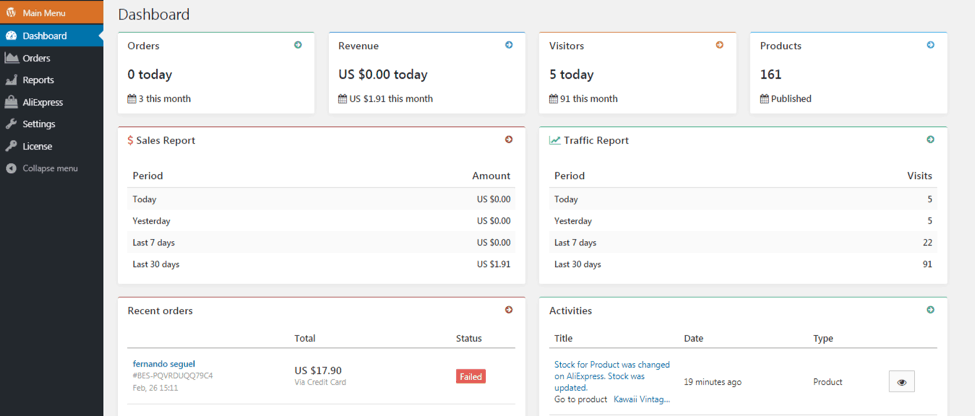
When you install the original AliDropship plugin and log in to view the admin panel, the first thing you see is a dashboard that shows the overview of your store stats (you can see the example below):

dropshipping tools

But, when you work with the AliDropship Woo plugin, it gets a little bit more complicated.

If you run a WooCommerce-based dropshipping store, you can view its stats in the internal admin panel, or use a different independent plugin for this purpose.

There should be a separate plugin for each separate task, remember?…

  5. Oh. But your AliDropship Woo plugin still processes the orders, right?

Certainly!

Both our plugin versions can automatically redirect the order information to original AliExpress supplier.

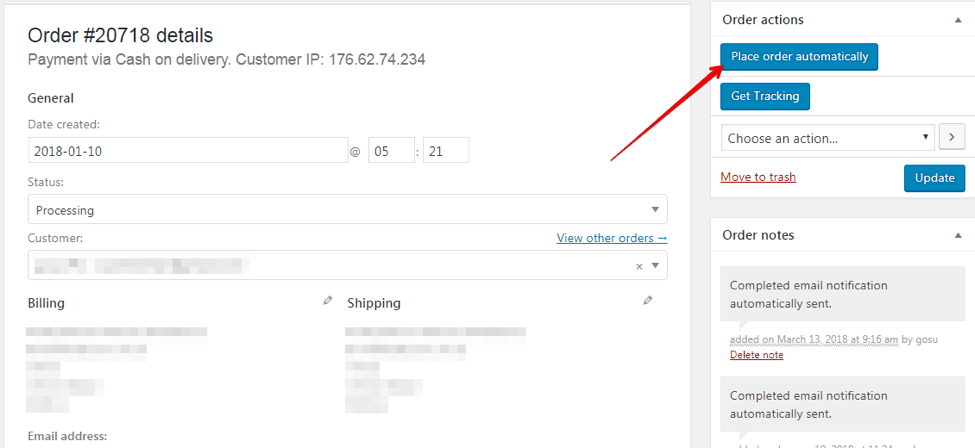
If you use AliDropship Woo plugin, you need to go to the WooCommerce section, then choose the Orders tab, and click on the order you need to redirect. When the window with this order details opens, all you need to do is click on the ‘Place order automatically’ button.

dropshipping tools

After this, the plugin will do all the job: it will visit AliExpress, select the necessary product variation, add the chosen items to your shopping cart, and write your client’s delivery address on the checkout page.

The only one action you need to take after this is click the Confirm & Pay button at the bottom of your page.

That’s it!

And for the AliDropship plugin, the orders processing is even quicker: you can read the step-by-step guide and view the video instructions here.

6. Are the shipping options identical for both the plugin versions?

Generally, AliDropship plugin allows you to select, set up, and modify lots of shipping options – you can read more about it here.

Still, there are differences.

When you use the original AliDropship plugin, all of your settings are automatically applied to all the deliveries arranged to any country on the globe.

When you use AliDropship Woo plugin, you need to deal with the so-called Shipping Zones: it means that you need to individually assign these settings for every separate region.

7. How do the plugins work with tracking?

If you have the original AliDropship plugin, simply read this article in our knowledge base to find out how to track the order details and how to automatically send the right tracking IDs to your buyers.

If you have the AliDropship Woo plugin, you need to do the following:

  • Enable your Google Chrome extension
  • Log in to your AliExpress account
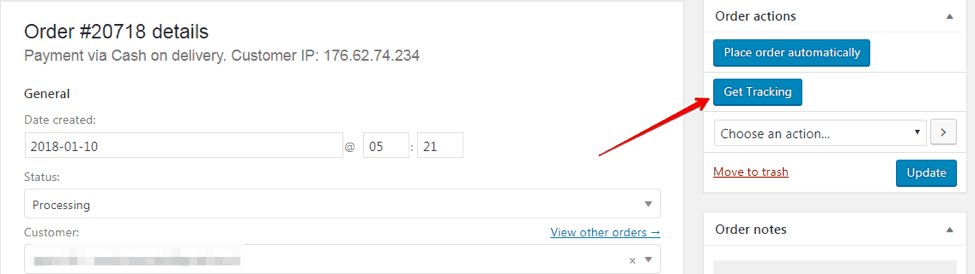
  • In a different browser tab, open the Orders section and hit the ‘Get tracking’ button
dropshipping tools

The plugin will synchronize your AliExpress account with your store and, if the original supplier has already provided the tracking ID, this number will automatically appear on the Order page.

8. What about payment gateways?

The original AliDropship plugin is compatible with the majority of the most popular payment gateways across the globe. Here you can view the list of payment gateways supported by AliDropship plugin.

With AliDropship Woo plugin, it’s a whole different story: WooCommerce itself supports almost every payment gateway that exists in the world. It means that you can go on the WooCommerce official website and download any plugin that attaches the necessary payment gateway to your store. Alternatively, you can look for the necessary plugins on the official websites of the desired payment gateways.

9. Can I install Woo plugin on a general WordPress site, or use the original plugin on a WooCommerce site?

dropshipping tools

Well…it’s not a really good idea in terms of compatibility and smooth working process, and here is why.

The original AliDropship plugin only runs effortlessly on general WordPress websites that have no WooCommerce plugin installed.

The AliDropship Woo plugin is specifically developed to be used on WooCommerce sites.

If you try to mix them up, your store simply won’t work as planned.

Please note: if you already have one of the plugin versions running, it will be quite time-consuming to switch to the alternative one as you will have to delete the current store contents and import all the products from scratch. 

10. Is the Woo version a good choice for a beginner in dropshipping?

Hmm.

As you have noticed it from the previous parts of this article, WooCommerce itself is a platform that requires considerable technical knowledge and/or development skills.

If you don’t have any experience in building websites and running online stores, we strongly recommend sticking to the original AliDropship plugin. It has all the necessary drop shipping tools already integrated, which is why you won’t have to waste your time and nerves on the selection and installation of additional plugins.

11. Okay, but…  I still can’t decide which of these dropshipping tools suits me better.

There’s nothing to worry about! Go through this tiny checklist and tick the statements you agree with.

  • I want a store with a totally unique layout that doesn’t look like anything else
  • I am a programmer / developer / IT person
  • This is NOT the first online store I’m going to have
  • I’ve tried all the basic dropshipping solutions on my previous stores, and now I want something a bit more interesting
  • I’m curious to assemble my store from lots of tiny details, like a Lego bricks dollhouse

Have you just ticked more than 4 statements? Go for AliDropship Woo plugin.

Have you just ticked less than 4 statements? Go for original version of AliDropship plugin.

From the video in our branded YouTube channel, you can learn more about the two types of dropshipping tools: the original AliDropship plugin and its WOO version.


That’s probably all you need to know about our dropshipping tools! So, which version of AliDropship plugindo you prefer?
This image has an empty alt attribute; its file name is shopify-banner2-1.jpg

How To Manage Social Media Accounts With Social Rabbit Plugin: Q&A Series #9

how to manage social media with Social Rabbit plugin

Lots of online entrepreneurs are wondering how to manage social media in the best way possible. To make it more time-saving and energy-efficient for our clients to run their drop shipping stores’ accounts on social media, we commonly recommend getting Social Rabbit Plugin. Here’s what you need to know about this awesome tool!

Why is this plugin recommended for social media management?

how to manage social media with Social Rabbit plugin

Let’s start with the basics: why should you even care about social media?

For any drop shipping store, a good-looking and regularly updated social media account is a blessing. It helps spreading the word about the wonderful store offers, proves that the business is alive and well, and lets your store get higher position on Google search results page.

Of course, it takes considerable effort to monitor and update multiple social media accounts of your store on a regular basis. As a drop shipping store owner, you have a bunch of other important things to do every day, which is why many entrepreneurs simply don’t research how to manage social media because they think it is not their first priority.

That’s exactly the reason why Social Rabbit was invented.

Social Rabbit plugin is a tool that helps you save time you’re spending on social media marketing activities.

Social Rabbit makes your store’s social media accounts look like you’ve invested hours of your time into thoughtful planning and careful crafting of every post (while actually you haven’t).

You simply select the necessary settings once, and the Rabbit uses these settings as the basis for its non-stop activity of managing multiple social media and placing high quality posts in every account.

The followers get highly engaged, the occasional readers become first-time buyers, and the loyal customers keep checking your account in search for a fancy new item or just a funny new post.

You’re getting so much for doing so little!

How to manage social media accounts with Social Rabbit? What can it do?

how to manage social media with Social Rabbit plugin

Okay, so there are 4 major social networks that have a more or less global coverage: Instagram, Pinterest, Twitter and Facebook.

Based on the settings you choose, Social Rabbit can automatically perform several types of actions in your store accounts on any (or all) of these social networks:

  • Publish your store products 

In this case, each post is dedicated to one of the products and services from your store: Social Rabbit automatically publishes a random item’s image along with its title, price, and link.

  • Make entertaining posts

Using the text templates, hashtags, and images you’ve previously added to the database, the Rabbit randomly combines these elements to create short-spoken, yet attractive and catchy posts. It will do all social media content marketing work for you. 

  • Repost blog articles

If you are running a blog in your store, you certainly want as many people as possible to read what you’re writing. Again, Social Rabbit randomly picks one article out of your blog posts, and places its link, title, and short extract in the relevant social media post. It is also possible to publish these articles in chronological order.

  • Sharing content generated by other users

To do this, Social Rabbit is scanning Instagram pages that contain the keyword(s) you’ve specified, and finding content published on these accounts. Then, the Rabbit reblogs these posts within the same social network: for example, it doesn’t repost Instagram posts to your Twitter feed, and vice versa.

  • Boost your social media accounts activity

Again, the Rabbit goes through the pages that contain the keywords related to your store niche. The Rabbit automatically follows these pages, likes the post published there, and even comments them in order to attract attention to your store social media profile.

It’s not always necessary to have all of these actions performed at once. It’s up to you to decide which of the plugin functions you enable now, and which ones you will turn on later as an experiment.

  • Search shoutout partners

This function is only applicable to your Instagram account. You need to specify the keyword(s) that are related to your store, and write a template message to ask for a business partnership (you can find an example here). The Rabbit uses the provided range of keywords to find appropriate Instagram pages, and automatically sends their owners the template message you’ve created.

How to manage social media automatically without getting a spammy-looking account?

how to manage social media with Social Rabbit plugin

People commonly ask us: will the Rabbit make them look like spammers?

It certainly will not, and here is why.

Consider this: how do you understand that a person is a spammer?

Most typically, we guess that an Internet user is spamming because his/hers actions look like something mechanical and even detached from reality. 

Their typical behaviour is to leave meaningless comments and even direct messages that commonly contain nothing but a suspicious site link and/or a short phrase like ‘follow me plz’.

Plus, these users do a really random mass following with no obvious pattern or reason: they simply add everyone they see (which leaves their ‘victims’ slightly confused). 

Finally, even if spammers make some effort to manage their own pages, their accounts don’t inspire much trust: they contain low quality images or poorly designed collages, and incomprehensible texts. What’s also remarkable, while figuring out how to manage social media, they don’t pay any attention to timing and place their posts with some weird frequency: their account can be silent for several days in a row, and then suddenly it bursts with activity which means you get forced to see dozens of questionable entries published in several minutes.

When you use Social Rabbit plugin, none of this happens.

It’s you who defines what will be written in the comments left by Social Rabbit: you prepare a database of possible message options, and the Rabbit only uses the phrases you’ve specified.

The same goes for photos and collages: you upload a range of relevant high-quality images that are dedicated to your store and to this whole thematic area in general, and the plugin never uses any extra sources to get the necessary images.

Also, you don’t start following hundreds of random people when you activate this plugin: you only add the accounts that are somehow related to your business niche. So, you exclusively attract attention of the people who are potentially interested in your store offers and, naturally, they are likely to make a purchase from you, or at least get curious about your social media account.

Obviously, the posting frequency settings can be customized any way you like it: Social Rabbit can schedule posts within the time frames you’ve set. It means you don’t have to worry about uncontrollable production of 20 publications in 1 minute!

And finally, there is one ultimate thing that makes it 100% clear you’re not a spammer: it’s the overall appearance of your social media pages. If they are set up and designed in a neat, professional and aesthetically appealing way, they leave no doubt about your reliability and fair business play. We have previously explained how to write a trustworthy and informative Instagram bio, but if you feel you need some additional help with this task, an expert service of social media creation might be a great solution for you. 

Will this social media plugin really boost my business?

how to manage social media with Social Rabbit plugin

Absolutely.

When it comes to sharing the knowledge about additional technical solutions for drop shipping stores management, our in-house experts performs meticulous checks of every recommended piece of software. This way, we can be completely sure we’re not promoting some malware, plus, we filter out the plugins and applications that don’t show any significant efficiency.

Social Rabbit Plugin is systematically used to boost profits in our own stores (as you probably know, our dedicated project team manages, promotes, and analyses the performance of several self-owned drop shipping stores). As the result, these specialists get the opportunity to test a full range of social media management techniques and scheduling tools, and deliver their experience to fellow entrepreneurs who have the same marketing needs – including the questions on how to manage social media!

The solid background of using Social Rabbit lets us safely say that this plugin:

  • Makes it possible to easily generate ‘human-like’ posts that don’t look spammy
  • Saves about 6 hours every day as the plugin produces ready posts that get published without extra management
  • Raises awareness about the promoted stores as the plugin helps to increase the number of social media followers
  • Attracts stable social media traffic to the stores in question
  • Boosts the number of orders placed in our stores as the plugin specifically attracts the audience that is likely to make a purchase

If you’re interested to find out more about our experience of learning how to manage social media with the highest efficiency, take a look at this articleIn this case study, we explain how we achieved 70,000+ Instagram followers for one of our stores’ accounts, show the stats on buyers’ behavior, and even provide a screenshot with the settings we’ve chosen for the Rabbit in this case!  

Speaking of which… how to set up Social Rabbit correctly?

how to manage social media with Social Rabbit plugin

From the technical point of view, the process of setting up Social Rabbit is quite easy and well-documented.

After you complete the plugin installation process, you first of all need to connect the plugin to the every social media account you will be promoting. It is done through the ‘Main Settings’ tab: in the Social Rabbit’s Knowledge Base, you can find the detailed instructions on enabling these main settings for FacebookTwitterPinterest, and Instagram.

Done?

Great!

Now, it’s time to specify what the Rabbit will be writing and posting on your social media channels.

You need to start with adding pictures to the Social Rabbit Gallery on InstagramFacebookTwitter and Pinterest: as we already mentioned it before, it’s a kind of a library or a database which the Rabbit uses to create a post. Sooner or later, each and every one of these pictures will appear in your social media posts, so be careful to only upload high-quality photos and attractive images

Also, you can instantly import free stock images from Pixabay.com and Giphy.com databases straight to your Media Gallery!

In order to specify the details of the actual publishing settings, go to the relevant ‘Posting Settings’ tab for  FacebookTwitterPinterest, and Instagram (for your convenience, each of these settings instructions pages has a relevant video tutorial included).

You need to assign its own posting settings for each of the social networks, but in general, they all cover the same parameters of these self-generated posts:

  • The posting frequency

You can set the exact amount of days, hours, and minutes that will be the periodic sequence of the posts.

  • The posting time randomizer

If each one of your posts gets published on exactly the same time (for example, at 10.00, 16.00 and 22.00 every day), your followers/subscribers might think it’s a spammy mechanical action. In order to make these posts look more ‘real’, it’s recommended to turn on the randomizer: it lets you pick a ‘deviation’ time period, and uses it to publish each the posts on a slightly different time.

  • Hashtags

If your social media post contains no hashtags, it won’t get discovered by people who are interested in this particular niche or area. On the Social Rabbit Posting Settings pages, you can easily write the hashtags that are relevant for the business focus of your store. Also, Social Rabbit plugin uses machine learning to look at any product featured image, and suggests the appropriate hashtags for this item.

  • Text templates

Here comes the most exciting part 🙂

It’s necessary to specify what exactly will be written in these carefully prepared self-generated posts. Remember that the Rabbit doesn’t write its own texts with the power of artificial intelligence 🙂

The idea behind the tool was to make these automated posts look as human-like as possible, so the system simply takes and randomly combines different pieces of content YOU have previously added to its database.

This is why it is so important to write short and slightly ‘abstract’ texts that match EVERY picture you’ve uploaded! Otherwise, it’s possible that the randomiser will make a meaningless post with a picture and a text not fitting each other at all. That’s a spammy-looking thing you need to avoid!

These texts are written in the Template field, and actually, it’s not only words and emojis that can be put there. The system also makes it possible to write so-called ‘tags’ along with the text. Each of the tags is a ‘shortcut’ for a specific action: for example, if you write the %URL% tag, the published post will include a product link, and if you write the %PRICE% tag. The post also will contain this specific product price. For your convenience, the full range of these available tags is written right below the Template field.

As you remember, the Rabbit doesn’t only publish self-generated posts: it can also repost the articles from your blog, and this is how you can set up the Blog Poster for TwitterPinterestFacebook and Instagram.

Apart from this, Social Rabbit also attracts public attention to your account because in can automatically follow other social media pages that contain the keyword(s) relevant for your store. For example, here you can read how to set up this smart mass following on Instagram.

Basically, almost every single one of all these settings have a wonderful ‘Set Recommended Settings’ button. This way, if you’re not really sure, for example, what posting frequency to choose, you can start with the default settings, and then slightly edit them as an experiment.

As you can see, Social Rabbit is a wonderful plugin that is proven to give businesses a considerable boost. Aren’t you curious to give it a try in your own drop shipping store?

This image has an empty alt attribute; its file name is shopify-banner2-1.jpg

Myth Busted: Is Dropshipping Dead?

is dropshipping dead

Is dropshipping dead? Does dropshipping work? Is dropshipping worth it? The answers to these questions are obvious – still, for some reason, they continue to bug thousands of people all over the globe.

When you are standing at the doorstep of your first dropshipping journey ever, most likely, you don’t know much about this type of business and its prospects.

This is why you go online in hopes to see dropshipping explanation for beginners, or a checklist of must-have things at the beginning, or the advantages of the dropshipping business model, or the opportunities for your future growth, or something like this, encouraging and helpful.

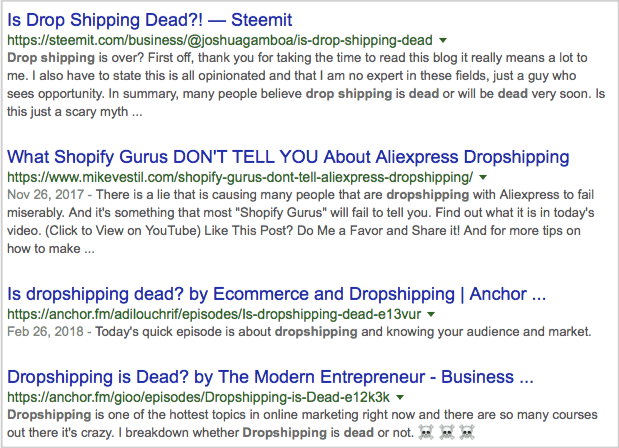
Instead, on your search results page, you see some terrifying things:

is dropshipping dead

Lol.

Sitting in one of the spacious downtown offices generously rented by our CEOs, and surfing the Web on my shiny Mac beside 50+ colleagues who develop, test and improve this business-related solutions, I personally giggle at all the hysteric Internet posts that pronounce dropshipping dead and claim it has no future.

And you know what? I strongly advise you to do the same and not to take any of these statements seriously.

Dropshipping will outlive us all, and here is why.

Why the answer to the ‘Is dropshipping dead?’ question is NO

Surely, there’s nothing funny about actual people’s worries and concerns: it’s natural to be anxious about the things you don’t fully understand or know yet.

People go online to learn more about the business they’re planning to launch, and obviously, they look for the advice of more experienced entrepreneurs.

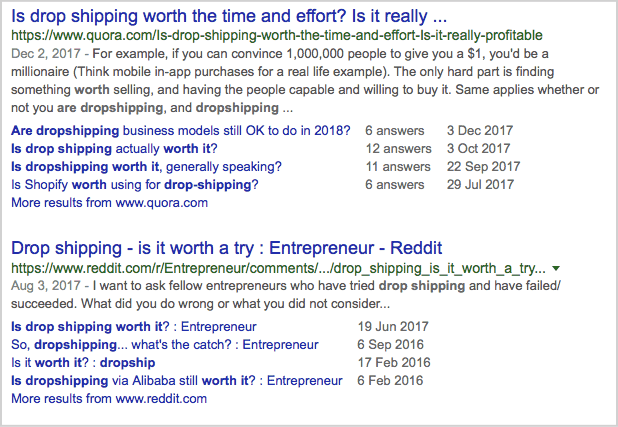
This is why Quora and Reddit, the forums aimed on solving the most pressing everyday issues, are filled with questions like these:

is dropshipping dead

There is absolutely nothing wrong about these questions: they simply show that dropshippers-to-be are genuinely interested in the financial prospects of this business, and (unfortunately) lack information on the topic.

The sad part, however, is that yellow press takes advantage of this public interest and speculates on it in the most misleading way possible.

So, let’s go through the most common arguments these ‘experts’ use while talking about the future of dropshipping.

‘Dropshipping is dead because its hype years are gone’

Oh, I beg your pardon.

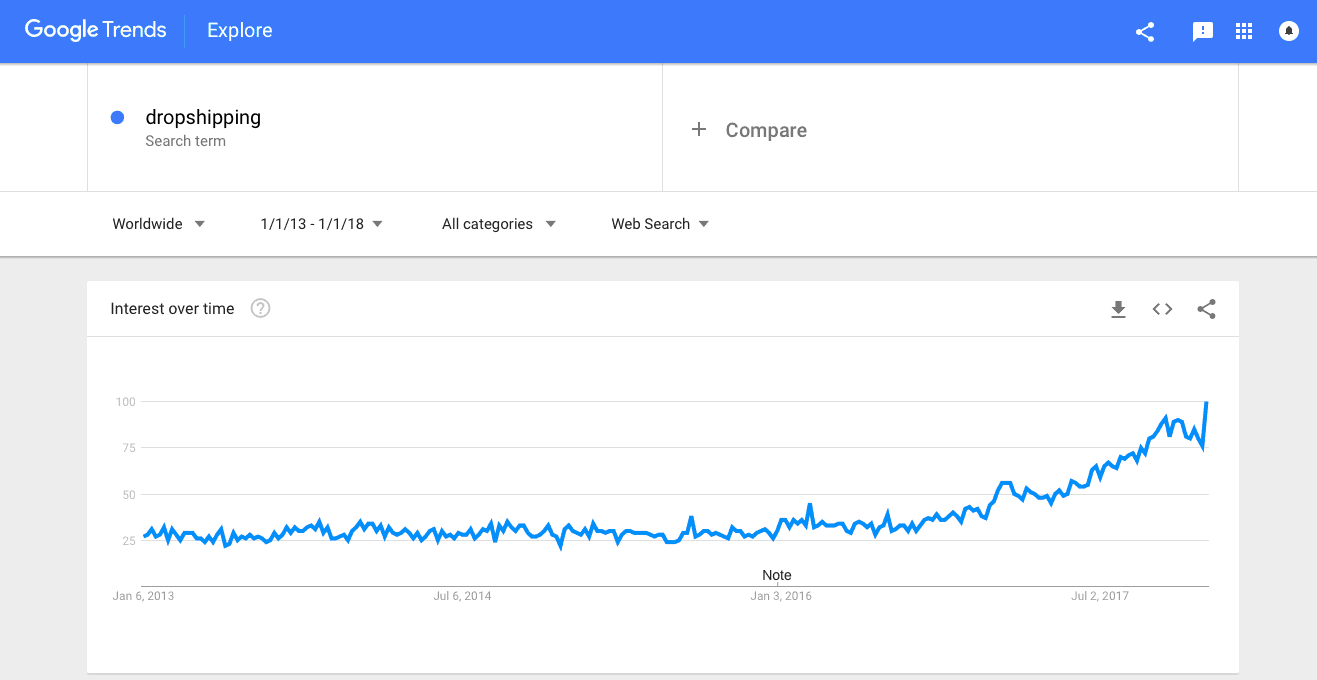
Here’s a Google Trends graph showing the frequency of searching for the ‘dropshipping’ term in the last 5 years.

is dropshipping dead

Can anyone seriously insist that the ‘golden era’ of dropshipping has already ended?

Is it even logical and sensible to say that ‘dropshipping was hot in 2010s, but it’s all over now’?

This graph clearly demonstrates that the number of business persons interested in dropshipping model is growing steadily no matter what – no political turmoils, wars, economic crises, etc. can stop people from pursuing their dream.

Plus, a considerable surge in public interest towards dropshipping has started less than a couple of years ago – it lets us assume that this whole business scheme is currently on its early growth stage, and the best is yet to come.

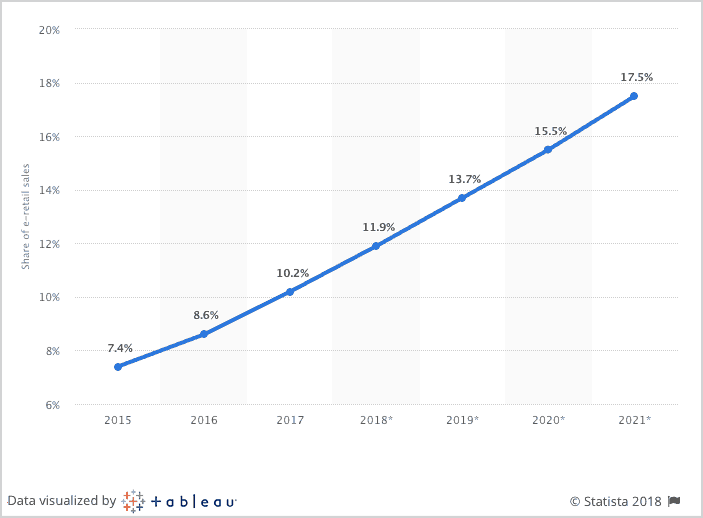
These assumptions are proven statistically: just take a look at this graph, and you’ll see that in 2017, the whole e-commerce industry accounted for only 10.1% of all retail sales worldwide.

is dropshipping dead

It’s only 10%! And for drop shipping business in particular, the number is even lower because clearly, not all of the e-commerce transactions can be classified as dropshipping-related actions (and we will talk about it further).

To sum up, drop shipping business has an incredible room for growth: on global scale, its operations now account for a small yet promising percentage of all the acts of purchase and sale.

This, in turn, leads to the following speculation…

‘Dropshipping is dead because of extreme competition’

is dropshipping dead

This is quite a common business fear: if something gets insanely popular in a short time period, all the related spheres instantly get overly saturated with entrepreneurs making profit from it.

In other words, the more demanded something becomes, the more intense the competition gets – so, if you’re not already in, you won’t have a chance to succeed.

Sounds slightly reasonable, but let’s take a quick look at the industry statistics.

As Statista researchers report, only in the United States, there will be 230.5 million digital shoppers by 2021.

Can you imagine the number of enterprises that is necessary to satisfy the needs of all these shoppers?

And don’t forget: it’s only the data for the United States! Take a look at other geographic markets, and you’ll see that it’s early impossible to create an ‘excessive’ online store – with due marketing efforts, there will be enough buyers for everyone. Southeast Asia’s Internet economy for example, is predicted to reach the $50 billion mark in 2018, and for 2025, the number is estimated to be around $200 billion.

So, it’s possible for a dropshipping store owner to successfully target any geographic market and reap the rewards of the business flexibility: its specific mechanism makes it easy for everyone to dropship from any country on the globe.

Still, the availability and affordability of launching a self-owned dropshipping store leads to the mass creation of the following myth…

‘Dropshipping is dead because you can make no money of it’

is dropshipping dead

This is my favourite part.

Dropshipping opponents dare to say that a business which is so quick to start and so easy to run can’t bring the owner any considerable returns.

To clear these doubts and get a full picture of what’s happening, again, let’s consider the global e-commerce trend.

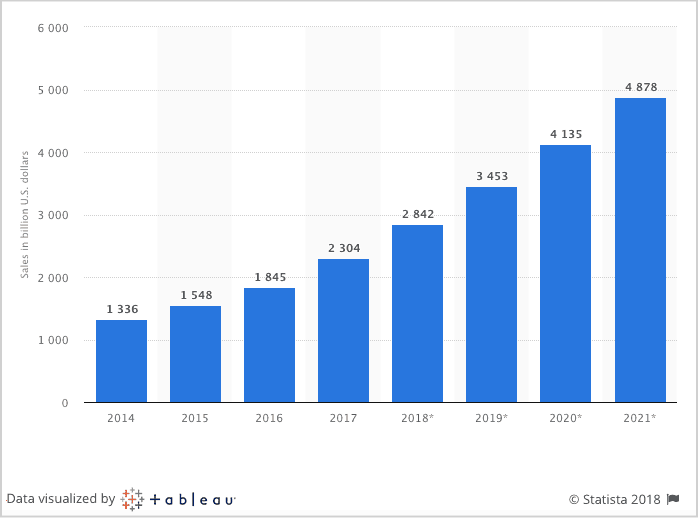
Judging by the Statista data, the expected volume of retail e-commerce sales in 2018 is due to be around $2,774 billion.

is dropshipping dead

At the same time Lehigh, one of the leading research universities in the USA, figures it out that dropshipping sales and purchases constitute 25-30% of all the e-commerce transactions.

It lets us roughly estimate that by 2021, the volume of global dropshipping sales in 2021 will exceed $1,500 billion.

Isn’t this number impressive enough?

Doesn’t it showcase a thrilling opportunity to get a fair share of this jaw-dropping amount of money?

Surely, you might say – ‘nah, it’s all about large-scale businesses, it has nothing to do with me, a mere mortal”.

But how, in your opinion, have all these multibillion-dollar empires started?

The incredibly inspiring example of Zappos shows that it only takes a first step to embark on this breathtaking journey.

Zappos, in the same manner as Amazon, has started from humble beginnings – but look what both of them managed to achieve in the course of time.

Each and every person proudly sharing their first dropshipping achievements, whether it be $600 revenue in the first two months or $3,000+ in sales daily, has the chance to build a mind-blowing e-commerce venture – and you can do the same, too.

On a $1,500 billion market, there’s a place for everyone!

Maybe, the next dropshipping success story will be written by you?…

This image has an empty alt attribute; its file name is shopify-banner2-1.jpg